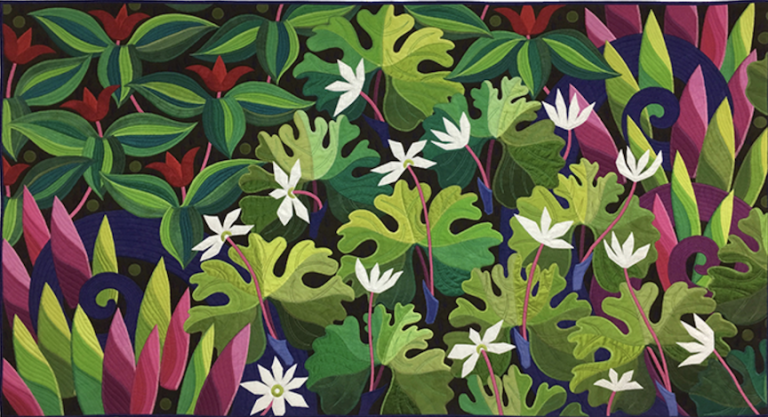

Jane Sassaman, fabric designer and art quilter, will be our March Quilt Day guest speaker and instructor. Guild members are encouraged to bring their friends and family as guests for free.
Editor’s note: Please see the Workshops page on our website for details on Jane’s workshops. Nonmembers store at this link. Guild members receive a discounted price on workshops, so you must use the Members store link.
What will someone learn from your Abstracting From Nature workshop?
This workshop is close to my heart. You will learn to simplify and exaggerate shapes. You will take a 3D plant shape and turn it into a 2D fabric object. You’ll take the time to “see” what you are looking at, discover the character, and then stylize or abstract it to make it yours. You’ll learn to identify the “rules” that your plant grows by.
What will someone learn from your Suns and Moons workshop?
I love shapes, shapes, shapes and moving them around! You will make a pile of donuts and discs. Next you will create a composition by moving them around and then stitching them in place using the decorative stitches on your sewing machine.
Who inspired you to quilt?
I always knew I wanted to be an artist. I was creating posters and using psychedelic paints in junior high school. I had art teachers in high school and professors in college. This was in the late 60s to early 70s when the Studio Crafts Movement was growing.
Glass artist Dale Chihuly, fabric artist Diane Itter and British impressionist and modern sculptor Albert Paley inspired me. And in the 1980s, I discovered American art quilter and fabric artist Nancy Crow. When I saw the engineering, stitching, aesthetic, scale, choice of color and material in Nancy’s art, I knew I was meant to become an art quilter. It was the aesthetic autonomy that I was looking for.
Do you personally try to create pieces each year that you can enter into juried quilt shows or does that not influence your process?
Most juried quilt shows want a very big, fabulous quilt. I make one every other year and then spend the next year recovering. I tend to make home scale, intimate quilts. They can easily become part of your life. They are affordable for collectors. I don’t make quilts for a bed.
Where do you see the fabric art and quilt industry five years from now?
I have no idea. I hope it’s going great guns, and I hope to be a part of it until I kick the bucket. I think SAQA is doing a great job. I also see the dilemma of craft vs. art becoming less and less which is a good thing.
How has social media influenced your position in the quilting/fabric art world?
I’m glad it’s there. I was a tough nut to crack initially. It’s great that you can see a friend’s work on the other side of the world any day of the week, at any time. It is a relatively easy way to share what you are working on and keep interest going. Before social media, I used to enter quilt shows which had show books produced. Then more folks could see your work in the book, if not in person. Now the internet does the job instead. I love following the work of artists all over the planet. I find it reassuring that the world is filled with so much talent and heart, especially during these times.
What are your sources of creative inspiration?
Mother Nature. I like working with plants. I look at them and filter them to become mine. In the classroom a daisy, for example, never turns out the same twice. I also take inspiration from design. I have a major library of illustration, gardening, and arts and crafts. I think I’ll order a few more books today!
What is on your design wall right now?
Smaller pieces. They are easy to travel with. I’m planning some class samples for more abstract ideas, shapes and decorative stitches (which are underutilized.)
Do you have a can’t-live-without-it notion in your sewing box?
1) Interfacing: I back all my fabric shapes with it. It gives stability and body, so you can work with your fabric like paper. 2) 12-weight thread: I use it for my quilting. 3) An easy threading needle and, of course, 4) my Bernina. I’m not a free motion quilter.
How can students reach out to you after class if they have any questions?
You may reach me at https://www.janesassaman.com.