Art quilter, Kevin Womack, will be our May 2026 Quilt Day guest speaker and instructor.
Editor’s note: Please see the Workshops page on our website for details on Kevin’s workshops. Guild members get a discount on workshops, so you must use the Members store link. Interested but not a member yet? Use the Nonmembers store link instead.
What will someone learn from your workshop Mark as Muse – Composition?
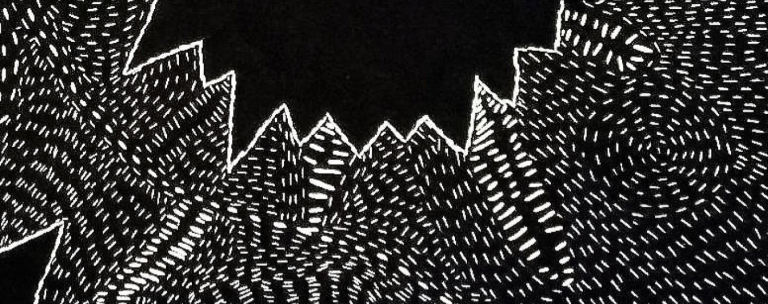
This class features an open-ended process where students will explore how mark making might help generate ideas for their art practice. This is not a drawing class. On Day 1, you will explore mark making where the goal is to help develop your own visual language. I will give you a series of prompts, including visual, sound, or going outdoors to help you find a source of inspiration. Next, on Day 2, you will explore the possibilities of manipulating, repeating, and enlarging the marks that you made and seeing where that leads.
What will someone learn from your workshop The Thread’s the Thing?
This is a half-day workshop where we will play with quilting using different colors of thread to illustrate the impact on the color of the quilted surface. In class, we will be using small squares or strips of fabric to practice.
Who inspired you to quilt?
After I lost my mother when I was 15, I started going to my maternal grandmother’s house on the weekends. We would talk about our family and genealogy. She taught me candlewicking, cross-stitching, and sewing. My grandmother really wasn’t a quilter, but she had a quilt top that my great-grandmother had made from old clothing that she wanted to finish and give to a family member. So, she set up the quilting frame in the basement. We wanted to use a fan pattern on the quilt, so we used chalk tied to a string to make our markings. I hadn’t mastered a quilting stitch yet, so my stitches were stab stitches.
Who was most influential on your art quilting journey?
In 2007, I had a class with the surface design artist, Jane Dunnewold from San Antonio. She showed me a path forward on how to put myself in my artwork and give it deeper meaning.
As a man, did you get teased unfairly about your textile hobbies growing up?
A little bit during my college years (mid-1980s), but I’m pretty resilient, though. I have always viewed my needlework as a continuation of my artistic pursuits.
How do you describe your quilting style?
Art quilting probably describes it best. I am more of a surface designer than quilter. I enjoy the process of printing my own fabrics and designing my own fabrics with Photoshop to print at Spoonflower. Sometimes there is a long lag time between the designing and the actual finished quilt.
How do you describe your teaching style?
I consider myself to be more of a guide than a teacher, especially in the Mark as Muse workshop. I can push you along, maybe even tell you what you need to do, but I want you to make the discoveries on your own. I think if you discover something yourself it is more useful to you and a better way to learn.
Did you ever have someone in the Mark as Muse workshop that didn’t find their mark?
Sometimes at the beginning of class, students may wonder “what exactly is the point of the exercises?” I encourage them to trust the process and not give up. It may take a little time to let it marinate. The class is meant to give students a framework for generating ideas, so there is no right or wrong. Hopefully, it will be springboard to a new way of working.
Do you personally try to create pieces each year that you can enter into juried quilt shows or does that not influence your process?
I do not make quilts for a specific show. I make quilts for my enjoyment. If I have made something and it fits in an upcoming call and timeframe, then I will enter my quilt.
Where do you see the fabric art and quilt industry five years from now?
(Laughing) I have no clue. I have noticed trends. I see a lot of people looking to YouTube and videos for online learning. That’s great, but I personally get more out of an in-person class. The in-person connection is vital for me.
Agreed. How has social media influenced your position in the quilting/fabric art world?
I don’t know that it has. It’s my least favorite part of my job. These days, you have to put yourself out there with an online presence, but I would much rather do the fun creative stuff like quilting or dyeing fabric. It may sound a bit old-fashioned, but I would rather people hear about me from word of mouth.
Note: Follow Kevin on Instagram @kwwomack
What are your sources of creative inspiration?
I can hearken back to my Jane Dunnewold class in 2007 that gave me a framework of untapped resources. I have barely scratched the surface of the subjects I explored all those years ago, so there is much more to explore there.
Visually, if I have an idea that interests me, I will play around with it in Photoshop and see if anything comes of it. These days, I lean towards using my mark making fabrics and merging them with my abstract photography.
Photography and working in the darkroom were my first love in college. However, my father wanted me to major in something employable after graduation. The options were computer science or economics. I graduated with a computer science degree, but I never lost my love for the camera or for the arts in general.
What’s on your design wall right now?
It’s a quilt inspired by genealogy and identity containing my previous promo headshot that I manipulated, printed, pieced and quilted. It’s called “Facade” and is about exploring the story hidden behind the face one presents to the public. It is going to the Virginia Quilt Museum, so it needed to relax on the wall for a bit first.
Note: See the two variations of “Facade” and Kevin’s other new works at this link.
Do you have a can’t-live-without-it notion in your sewing box?
As I age, a good needle threader!
How can students reach out to you after class if they have any questions?
You can reach me at kwomackart@gmail.com. I stay busy teaching and traveling so you might not get an immediate response. I promise to get back to you as quickly as I can.