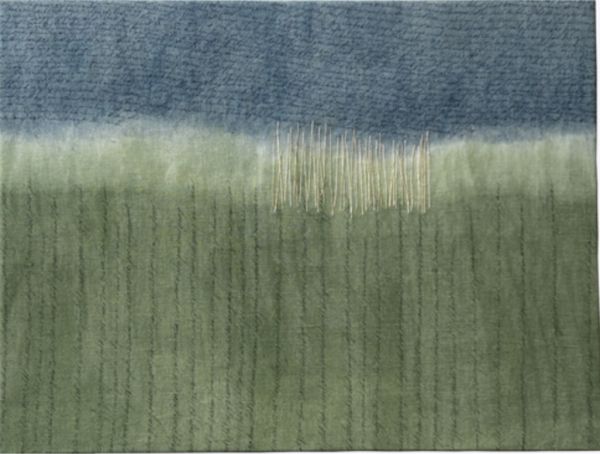

September’s Quilt Day theme is “Keeping it Local”. Debbie Grifka will be our lecturer. (The quilt shown above is Debbie Grifka’s Listen to This … ) Mary Bajcz and Kathy Schmidt will be our dynamic instructor duo.
Editor’s note. Nonmembers store at this link if you want to attend September’s QD meeting on September 19th.
MH: Let’s get started with our workshops. Mary, what will someone learn from your Scrap Happy Handbags workshop on Friday?(This workshop is sold out, to put your name on the waiting list email: workshopregistrar@gaaqg.com.)
MB: For my Scrap Happy Handbags, I’ve been making simple bags from beautiful patchwork rectangles for 25 years. One can make all kinds of pouches and bags from simple rectangles with no patterns required. When you realize a rectangle can become a bag with a simple boxed bottom, lots of possibilities open up. I’ve made bags from quilts that didn’t have a foreseeable future and always look at fabrics with an eye for their potential.
MH: Kathy, what will someone learn from your Beading Bling for Quilts workshop on Saturday? (One slot available.)
KS: Beads can add sparkle and enhance designs on a quilted piece and students will learn several methods in which to do that. All class techniques can be used immediately on any project!
MH: What will someone learn from your workshop that you are co-teaching with Kathy Schmidt, Become an Improv Expert?
MB: When I discovered free cut/improv piecing, I knew I’d found my artistic voice. I love the serendipity in this process. It makes every part of making a quilt fun and interesting because you don’t quite know what’s going to happen next. I love that! I hope some students will enjoy this way of working as much as I do.
KS: Confidence! With improv there are no mistakes, only alternate design decisions. There will never be anything holding them back from grabbing fabric, a rotary cutter and stitching up a unique design.
MH: Who inspired you to quilt or who was/is your most influential mentor/influencer?
DG: No one in my family quilted. I became interested during the Bicentennial era and began quilting about 24 years ago in 2002. Before that, I was doing garment sewing. I signed up to be a member at (our) guild, took classes at Quilting Seasons, watched quilting shows to learn. My first quilt was an applique design which I never finished, but I later discovered I preferred applique over piecing. I’ve also been drawn to Amish quilts. I didn’t think I was creative but about 5 years into my quilling journey, people would tell me how creative I was designing my quilts.
I think Weeks Ringel and Bill Kerr of Modern Quilting Studio were the first to inspire my early work, particularly after finding their book “Modern Quilt Workshop” which helped me focus on the style of quilts I wanted to make.
MB: I’ve been making quilts for 50 years; I started during the bicentennial by making a nine-star Lone Star English paper-pieced quilt demonstrated by Erica Wilson on her needlework public television show. Karen K. Stone, Eleanor-Burns… I developed free cut piecing based on the work of Nancy Crow, Jan Mullen, and Gwen Marston. Current influences are Albert Cote and Olayami Dabls.
KS: My grandmother made quilts that were always a part of my life, but she was only a memory by the time I actually started making them. I was attracted to the geometry and precision of traditional quilting. I have always loved textiles and every quilter with any new technique inspired me to learn as much as I could. Probably Gwen Marston, Katie Pasquini-Masopust and Jan Mullen started me on the path to improv, but it was Ricky Timms who gave me the confidence to play and experiment.
MH: How do you best describe your quilting style/instructor style?
DG: Modern. Minimal. Graphic.
MB: Spontaneous and intuitive. I’m not a perfectionist.
KS: My quilting style is bold, bright and abstract. My instructor style is both strict, laid back, and independent study all in one class. I encourage creativity and questions at every point.
MH: Do you personally try to create pieces each year that you can enter into juried quilt shows, or does that not influence your process?
DG: It does not influence what I make. If I see a call for entry and I have a quilt made that fits the requirements, I may enter it. It can be a good incentive to get a quilt done in order to meet the deadline. The exception to this is if I see an enjoyable subject, I may make a quilt to enter.
MB: I belong to groups that like to enter shows, so I’m sometimes part of that. I sell my work on Etsy and in a gallery.
KS: I do not create anything specifically to enter into shows. All my pieces are from my creative imagination, made strictly for my own enjoyment. When I do participate in a challenge, I try to overlay my style on whatever the parameters of the challenge are. It’s also good to remember that juried shows are assembled to fit the particular feel of that show and those jurors. A judged show is able to allow judges’ comments to aid your growth and skill.
MH: Where do you see the fabric art and quilt industry five years from now?
DG: I see lots of trends. Some are more predominant like the introduction of different fabrics and recycled fabrics, and the 3D element being added to quilting. I would like to see all quilts to be considered art beyond the traditional perception of grandmother’s flower garden quilts.
MB: People like to make things, both functional and artistic. That will continue bringing joy to the world.
KS: What goes around comes around and many of the current popular designers seem to be returning to many of the traditional patterns and fabric designs that I started out with. It’s ‘vintage’ and ‘retro’ and very popular. I also see more interest and respect for the art involved in all textile work and I certainly hope that trend continues!
MH: What are your sources of creative inspiration?
DG: My sources of inspiration come from inside of me, not external. I start with an idea and the fabric comes second. If I can’t find the fabric, I have started painting my own.
MB: Fabric! Fabric talks to me. Also traditional blocks and simple shapes in nature: fruits, veggies, birds, flowers…….
KS: Most of my inspiration comes from a juxtaposition of color and design that passes in front of me. That spark leads me to contemplate, experiment and play until I finalize a piece.
MH: Do you have a can’t live without it notion in your sewing box?
DG: Yes. It is a Roxanne Thimble that I use for hand sewing. It is open on the backside. The first time I put it on, it felt like part of my hand. I bought it years ago when I was garment sewing.
MB: Definitely a rotary cutter!
KS: The indispensable rotary cutter changed my quilt life from tracing templates, adding seam allowance and cutting with scissors. That was the most revolutionary tool in the 50+ years I’ve been quilting and it totally changed the industry.
MH: How can people get in touch with you?
DG: You can email me at debbie@debbiegrifka.com, go to my website at https://debbiegrifka.com or Instagram: @debbiegrifka, You can sign up for my newsletter here.
MB: Mary Bajcz Scrap Happy on Facebook; maryebajcz@gmail.com. If one Googles my name, Mary Bajcz, both my Etsy shop and my YouTube channel pop up. Both are named Scraphappinessstudio. Thank you for this opportunity to share!
KS: The best way to contact me is through my email quirksltd@gmail.com.