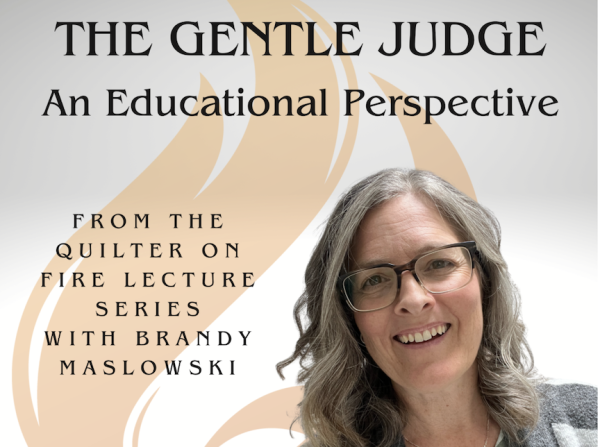

Brandy Maslowski is known internationally as Quilter on Fire. She is a quilt artist, educator, author, and certified judge from NACQJ (National Association of Certified Quilt Judges). Brandy is our upcoming July Quilt Day guest speaker and will be our 2027 Quilt Show judge.
Based in Summerland, BC, Canada, Brandy’s award-winning podcast has over one million downloads and 250 episodes. Her podcast has recently celebrated the 5th year anniversary.
Editor’s note: Learn about the ins and outs of a judged show by attending our July 18 Quilt Day. Nonmembers purchase a ticket here or at the door.
Brandy, I think you planted the seed for having a judged portion in our next quilt show. Getting our quilts “judged” seems a little intimidating. Personally, you don’t seem judgy or intimidating. What can we expect to be judged on?
I know it can feel daunting to think about having your quilt judged for the first time. So here is the general idea of what a judge looks for:
Judges often have an order of judging in their head that they follow to compare quilts in the same category. Keep in mind we may only have 3-5 minutes with each quilt.
From there a judge may set the top quilts in the category aside to be held for other special awards like best quilting, or Best in Show. Every show has different special awards. This is when we start to look at the degreeof difficulty (DOD) involved in making the quilt and the complexity of design (COD).
You have been selected to be a judge for Quilt National, 2027, exciting! What made you decide to become a judge?
First, I am so honored. To jury Quilt National is a bucket list experience for me. I am an art quilter, so this is a milestone for me.
Back to your question, why did I become a judge? In my early years of quilting, I quickly became an art quilter and felt out of place in my guild. I was not doing traditional quilting and modern quilting wasn’t big yet, so I felt a little out of place. I would show my work at show & tell and they were positive but would say, “That’s interesting.” Because I didn’t feel like I fit in, I wanted to learn all forms of quilting. One day my friend and quilt judge Wanda Steiner invited me to shadow her. I fell in love with the educational aspect of what a judge offers and she taught me so much. I started learning every technique I could find. If I didn’t know how to make a cathedral window, I would make it four ways. I went on this path to surround myself with friends and mentors in the quilting and judging world who lifted me up. It was a great foundational path to becoming a judge.
What does it take to become a judge?
I took a program in the USA called NACQJ (National Association of Certified Quilt Judges). Becoming a certified quilt judge isn’t a weekend course. It took me the better part of five years. You’re learning to walk up to a quilt, study it carefully, and say something useful. Not vague. Not flowery. Something the maker can take away.
The program requires years of dedication to the study of workmanship, styles, and techniques found in quilt making. The process from candidate to certified judge builds real skills: how to talk about a quilt with confidence, how to handle tough questions gracefully, and how to give every single entry the same respect whether it’s barely held together at the seams or a top contender in its category. Written modules, assessments, mock judging, a live panel interview – the NACQJ program is a long, tough process. You have to be willing to work hard for years and earn it.
That sounds pretty intense. Everyone has colors, patterns, and styles that they are drawn to. How do you not show favoritism when you judge.?
You’re right! I do have preferences. I love a well-executed art quilt, I’m drawn to bold color, and I’m an absolute thread geek. Any judge who tells you they don’t have preferences isn’t paying attention to their own reactions.
But the difference between preference and favoritism is where the work happens. My job isn’t to find a quilt I want on my own wall. It’s to evaluate how well the maker achieved their intention, and how well it fares against everything else in its category. My personal taste is irrelevant.
The criteria are the equalizer. When I’m looking at workmanship, design principles, and execution, I’m asking objective questions: Is the tension consistent? Do the design elements create movement and visual balance? Does the quilting support the piecing? Those questions don’t change because I prefer one color palette over another.
And when I come across something that I have never seen before it can be a good sign of innovation. That’s not a flaw in the system; that’s the system working. A judge can set their personal biases aside and be fair.
Where do you see the fabric art and quilt industry five years from now?
That’s a great question in this new world of AI that we are experiencing. It’s hard to predict the future. Since we may not know what’s real or not online anymore, I really hope quilters get even more deeply involved in their in-person guilds.
And my creative wish for quilters is for them to lean into their own personal creative art practices. There is so much free content and so many social groups out there online that quilters can find what they love most, take a deep dive and just spend time doing more of that. If they put in the hours and become highly skilled at what they love most then they can turn around and give back to beginners coming up. It’s all about community and personal growth.
I think it’s important to do what you love, share your expertise, and lift others up along the way. This is exactly what I aim to do with my podcast. I see this industry continuing to grow and not slowing down any time soon.
You have a large presence in social media. How has social media influenced your position in the quilting/fabric art world?
I do have a wonderful community, especially with my podcast. Gosh, I love the people who listen to my podcast.
Honestly? I’m not a natural social media enthusiast, but I am a community enthusiast, and that distinction matters. Social media became the distribution engine for my podcast, turning what could have been a local conversation into a global one. It’s connected me with makers, traditions, and ideas I’d never have found otherwise. I’ve learned to use it strategically rather than compulsively.
Social media can be used for great benefit. My advice? Delete the excess. Only choose the platforms and creators that you absolutely love. Click, like, share. Do everything to engage with them so they come up in your feed first. You are training the platform algorithm to show you more of what you love and less of the junk. For me it’s always been about the people on the other side of the screen, the community, and that’s the same thing that drew me to quilting in the first place.
I think you have built a community.
For sure. If a Tuesday goes by and my podcast has not aired by 1 o’clock Pacific time, I get emails asking if I am okay. It’s a delight that people listen in every week and they really care. It means the world to me.
With your busy schedule, do you still find time to quilt?
No, it’s my biggest struggle. My personal art practice always falls off the bottom of my task list. I try to give myself the grace of time to quilt but I tend to put myself last. I do manage to complete one new quilt every year or two and I’ve set up accountability with friends to keep my art practice going even if it is only 15 minutes here and there. I also do a few annual retreats each year where most of my own work gets done.
If so, what is on your design wall right now?
Right now, I am working on a quilt called “Wax and Wane”. I already have the title, the inspiration and the idea for it. It’s about a daily comfort I have in my tea which is honey. And of course, if you dig deeper into the title, you’ll notice that wax has everything to do with honeybees, and wane gives a nod to the worry that bees are in global decline which could wreak havoc on our food supply.
I have half of the background on the design wall. My vision is to create this beautiful big teal background with giant improv hexagons that shift from dark to light in a gradation. It will have a gigantic bee on top of it with dozens of textures of gold and black. I’m hoping to finish it in early 2027.
What are your sources of inspiration?
I love to get out into nature. Much of my work is inspired by the colors of what I see – walking my dog, hiking, or riding my bike every day. I also love art museums and galleries when I travel away from my small town. We learn so much from other artists.
And one thing that is not too small to mention is noticing the small things that could inspire a quilt like a tile sidewalk or a hotel carpet. I have way too many photos saved on my phone because I take inspiration from everywhere and everything, it’s good for your work.
Do you have a “can’t live without” notion in your sewing box?
I do have a new tool from LDH Scissor Company, a little black snip that I really love. It’s right beside my machine.
Brandy, thank you so much for your time for this interview. We are looking forward to hearing your lecture in July and I’ll see you at the Quilt National opening in 2027.
It was a pleasure to chat with you, and I can’t wait to see you soon!