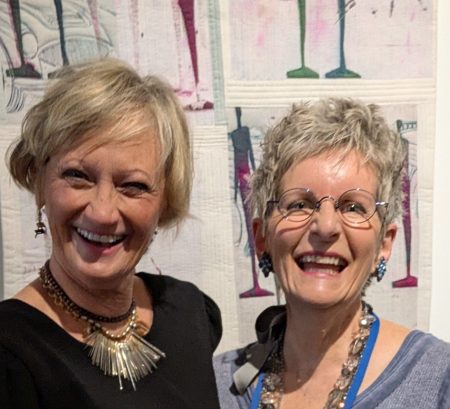

Lilo Bowman is our speaker for July Quilt Day weekend. She is President of Studio Art Quilt Associates (SAQA) and Editor-in-Chief of The Quilt Show. To learn more about Lilo and preview her talents, watch her introduction video at Lilo Bowman and check out her book Love Your Creative Space.
I recently had the pleasure of meeting with Lilo Bowman via Zoom in her studio to learn a little more about her. We were both excited to be attending the opening night of Quilt National in Athens, Ohio which runs from May 23 – September 11, 2025. Here is what she had to share with us.
What will someone learn from your lecture, Love your Creative Space?
You will learn that your studio is your personal space. You’ll decide what your personality is, what you gravitate toward, and start from there.
A lot of times, we have collected things throughout the years and it gets stuffed in the back of the closet. You don’t see it, it never sees the light, and you don’t use it. How often have you spent hours–if not a day or two–looking for something in your studio and you can’t find it?
The lecture will give you different options on how to tackle organizing your studio, whether you do it all at once, methodically, or with a friend. I will research places in your area to donate the items you are ready to let go of. I will also provide you with a handout before the lecture that you can print out with this information.
Who inspired you to quilt?
I fell into quilting. In 1984, I saw a magazine with a “Quilt in a Weekend” pattern. You used cardboard templates and hand quilting. Coming from a garment making background, I struggled with the conversion of 5/8 inch seam allowance to 1/4 inch. I was glacially slow at the hand sewing as I wanted my stitches to look like the ones in the magazine. It took longer than a weekend.
Two years later, I was living in Turkey, pregnant with my first son, and started quilting again. As a military spouse, it was a good way to upcycle my husband’s old military uniforms into coats for the kids. Then in 1998, we moved to Kadena Air Base in Okinawa, Japan and I was looking for something creative to do. By this time, machine sewing and rotary cutters were acceptable methods of quilting and their show-and-tell blew me away. This is where I learned the fundamentals and basics.
How do you best describe your quilting style?
My quilting style is eclectic. Most of my quilts these days are for someone specific, so it depends on whom I am making a quilt for. I don’t have much time for quilting these days, but I do make two quilts for the SAQA Spotlight and Benefit auction fundraisers.
Where do you see the fabric art and quilting industry five years from now?
There is something for everybody and every interest. Whether you are a traditional quilter or embrace technology, there is a lot of overlap. You might design a pattern on your iPad, print the fabric on demand, use a computerized long-arm quilting machine, and hand sew embellishments. I love that people are choosing a little of this and a little of that. Thank goodness there aren’t any rules.
How has social media influenced your position in the quilting world?
Social media helps get the word out. I’m not as active as I once was. I’m busy these days, working 18 years at The Quilt Show, SAQA, and being an author.
Social media allows me to share how I approach organizing my space. One year ago, I rolled out a 30-Day Challenge as a slow way to declutter. You start with one item one day, two items on the second day, etc. So, each day you add one more item. In 30 days, you have removed 485 items. I shared my decisions on Instagram. Your decisions might be different from mine. Many people felt a little nervous at first but as the 30 days progressed, they universally were excited and felt lighter, leaving more space for creativity.
What is your “I can’t live without it” notion in your sewing box?
Actually, I have two: seam rippers and an awl. I recommend the Clover white seam ripper and their retractable seam ripper. The handle is rounded and easy to hold in your hand. Their curved tailor’s awl is great for guiding fabric when sewing.